A guide for patients
Mohs Micrographic Surgery
Skin cancer is removed in stages and examined under a microscope during surgery. Explore who may benefit, how the procedure works, and what to expect before and after treatment.
In Brief
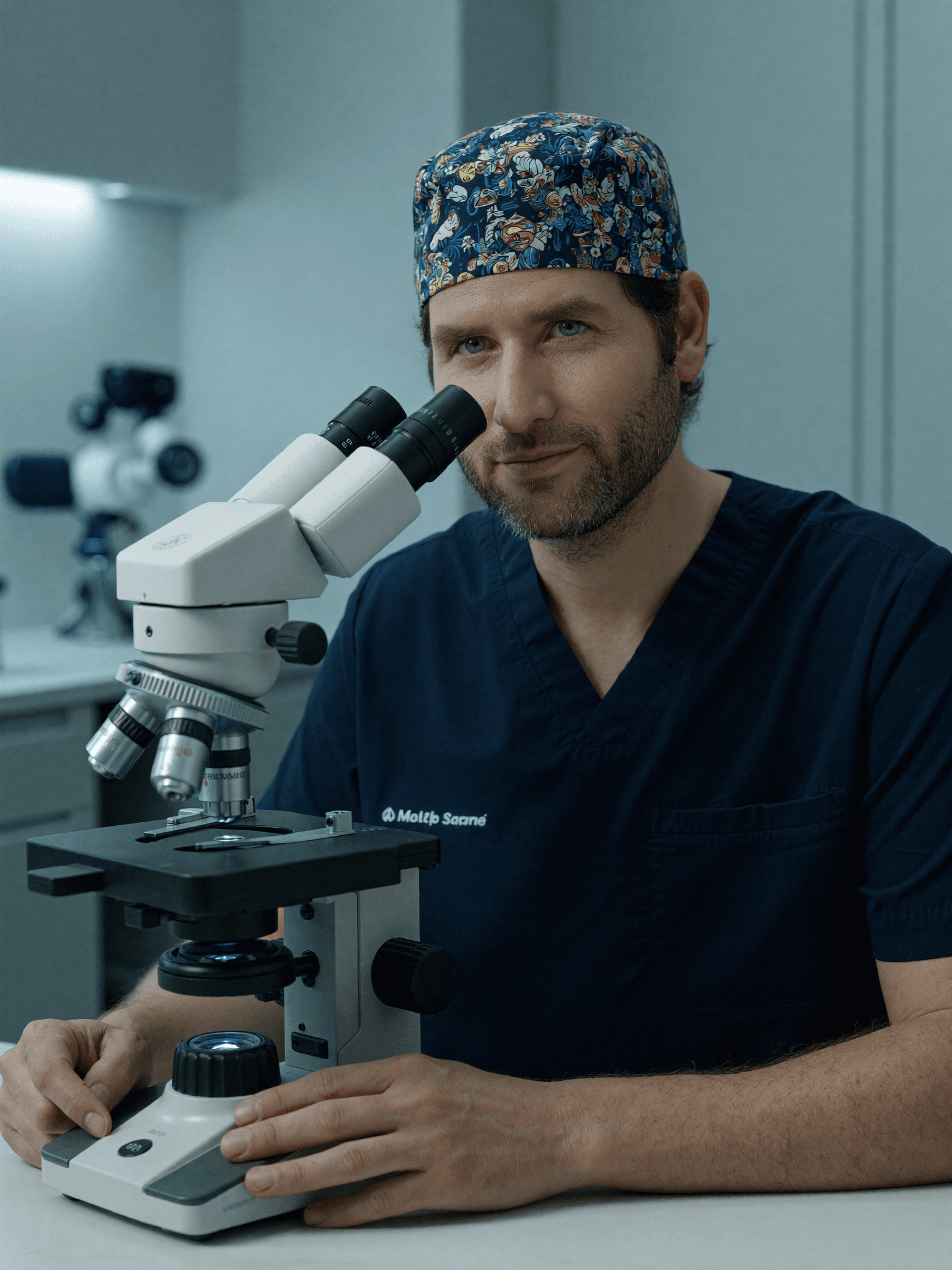
Mohs surgery is the most precise surgical technique for removing skin cancer. Instead of sending the tissue to an outside lab and waiting for results, we examine it under a microscope during the same visit. If anything remains, we remove an additional layer the same day. This way the entire tumor is removed while preserving as much healthy tissue as possible. This matters most for tumors on the face, lips, nose, and eyelids. The procedure is performed under local anesthesia, and patients return home the same day.
What Is Mohs Surgery?
Mohs surgery was developed by Dr. Frederic Mohs in the 1930s. During the procedure, the surgeon removes the visible tumor along with a thin layer of surrounding tissue, maps it precisely, and examines 100% of the margins under a microscope, all during the same procedure. This process repeats until all margins are completely clear of cancer cells.
Why Choose Mohs Surgery?
| Criteria | Mohs Surgery | Standard Excision |
|---|---|---|
| Cure rate (primary tumor) | Up to 99% | 90-95% |
| Cure rate (recurrent tumor) | Up to 96% | 50-65% |
| Margin examination | 100% of margins examined | 1-5% of margins examined |
| Tissue preservation | Maximum preservation | Fixed safety margins (4-6mm) |
| Cosmetic outcome | Optimal | Depends on excision size |
| Best suited for | Face, head, neck, sensitive areas | Small tumors on body |
Who Needs Mohs Surgery?
Mohs surgery is particularly recommended for:
- BCC and SCC on the face, head, and neck
- Recurrent skin cancer after previous treatment
- Tumors with poorly defined clinical borders
- Large tumors (over 2 cm)
- Aggressive histologic subtypes (morpheaform, infiltrative, micronodular BCC; poorly differentiated SCC)
- Tumors near sensitive areas (eyes, ears, nose, lips)
- Patients with compromised immune systems
Conditions Treated with Mohs Surgery
What Are the Steps of Mohs Surgery?
Preparation & Anesthesia
The surgeon marks the tumor and injects local anesthesia. The procedure is performed under local anesthesia only; no general anesthesia is required.
First Layer Removal
The surgeon removes the visible tumor along with a thin layer of surrounding tissue.
Mapping & Processing
The removed tissue is precisely mapped and sent for frozen section processing in the adjacent pathology lab.
Microscopic Examination
The surgeon personally examines the tissue under a microscope, checking whether all tumor margins are clear.
Additional Layers (if needed)
If cancer cells are found at any margin, the surgeon removes another layer only from the affected area. This process repeats until all margins are completely clear.
Reconstruction
After complete tumor removal, the surgeon performs aesthetic reconstruction of the area.
Preparing for Surgery
- Eat a light breakfast, continue regular medications
- No creams, makeup, or jewelry near the surgical site
- Bring ID and insurance card, arrive 15 min early
- Arrange a ride home
- Wear comfortable clothes, plan for a full day
Recovery & Aftercare
- Minor bleeding is normal: apply gauze pressure for 20 min
- Paracetamol for pain; no aspirin or ibuprofen for 2 weeks
- Ice 48 hours; daily bandage change with antibiotic ointment
- No pools, sauna, or strenuous activity for 2 weeks
- Suture removal in 7-14 days
Insurance & Health Basket Coverage
Mohs surgery for BCC and SCC in the head and neck area is included in the Israeli health basket. Maccabi members can undergo the procedure at Assuta Hospital (Ramat HaHayal or HaShalom) through their health fund. Clalit members can have the procedure at HMC after obtaining Form 17. For tumors on the body and limbs, supplemental insurance may be required. We recommend confirming coverage with your health fund in advance.
Have a referral for Mohs surgery?
Find the documents needed, surgery locations and insurance information in one place to help you arrange your procedure.
What to prepare for schedulingNo referral yet?
If you do not have a specific referral for Mohs surgery, the first step is a preliminary consultation.
Schedule a ConsultationResearch & Publications
Dr. Kaplan is an active researcher in the field. In 2025, Dr. Yehonatan Kaplan and Dr. Baruch Kaplan published a review article in the Israel Medical Association Journal (IMAJ) on indications for Mohs surgery outside the head and neck area. This is original Israeli research that contributes to the global body of knowledge in dermatologic surgery.
Kaplan, B., & Kaplan, Y. (2025). Mohs micrographic surgery: indications for non-head and neck tumors. Israel Medical Association Journal, 27(6), 395-397.
Planning for Mohs surgery and recovery
Guides to choosing a surgeon, understanding the procedure, preparing for surgery and recovery, with information about Dr. Yehonatan Kaplan’s training and experience.
The Biopsy Site Has Healed: Do I Still Need Mohs Surgery?
A skin biopsy site can look clear while questions about further treatment remain. Understand the evidence and prepare useful documents and questions for your consultation.
Read the guideUnderstanding Your Skin Biopsy Pathology Report
A skin biopsy pathology report contains the medical terms that determine your treatment plan. Learn what benign, atypical, and malignant mean, how to read margin status, and what happens next based on your results.
Read the guideHow to Choose a Mohs Surgeon: What to Look For
A practical guide to evaluating Mohs surgeons, including the importance of fellowship training, the right questions to ask, board certification versus fellowship distinctions, and how to navigate the referral process in Israel.
Read the guideMohs Surgery vs. Standard Excision (WLE) - What's the Difference?
A detailed comparison between Mohs micrographic surgery and standard wide local excision. Cure rates, tissue preservation, and which method suits which patient.
Read the guideMohs Surgery: Complete Before & After Instructions
Everything you need to know before and after Mohs surgery: what to eat, wear, and bring on the day, plus wound care, pain management, and recovery milestones in the weeks that follow.
Read the guideWhat you are agreeing to before Mohs surgery
A consent form lists everything that could happen, however rare. In a study of 20,821 Mohs procedures, any adverse event occurred in 0.72% of cases. Here is what the form says, in plain language.
Read the guideMohs Surgery Recovery: A Week-by-Week Healing Timeline
Knowing what to expect after Mohs surgery can ease anxiety and help you heal optimally. This detailed timeline covers every phase from the first day through the final cosmetic result at one year.
Read the guideMohs Surgery for Skin Cancer on the Nose: What to Expect
The nose is the most common location for basal cell carcinoma, making Mohs surgery the ideal treatment choice. Learn why the nose requires special surgical expertise, what reconstruction options exist, and how Dr. Kaplan achieves excellent cosmetic outcomes.
Read the guide
This medical content was reviewed and verified by Dr. Yehonatan Kaplan on April 8, 2026